Showing posts with label Miyagi. Show all posts

Saturday, 23 July 2011

Ippon Matsu: 4 months on

Last weekend I went on a two-day trip up to Rikuzentakada, Iwate and Minamisanriku, Miyagi with THJ. We usually go to Iwaki, Fukushima where the tsunami reached between 6m and 9m, unprecedented for that area in the last thousand years but up North in Miyagi and Iwate where they get them more often, the tsunami was on average 16-17m high and in places where the looping bays and headlands refracted the power of the surge it reached as high as 38m. More about historic tsunamis in a later post.

I wanted to see what had changed between my last trip up there seven weeks after the tsunami when food and supplies were in urgent need, and this one for clean-up work which was just over 4 months after. It seemed at first like nothing had changed with so much debris still around but the roads were now mostly open, the makeshift pontoon bridge in Minamisanriku had been replaced with a new tarmac’d two-lane bridge, food supply lines seemed to be back up and running, the army had moved out of the sports-centre/evacuation-centre in Minamisanriku (replaced by volunteers) and were now working through the hundreds of smaller villages that still remain untouched, clearing the roads and rebuilding the bridges. Japan doesn’t have an actual army they have a Self-Defence Force but let’s just call them the army easier.

In Rikuzentakada, about 80% of the town’s 8,000 homes were destroyed. From a population of about 26,000 over 10,000 people are now dead or missing.
Rikuzentakada is also the home of the Ippon Matsu, or the single pine tree. The beach area here, Takatamatsubara, used to be have about 70,000 pine trees. It started at the main rivermouth and curved East out of town. I came through here in 2004 and had to stop the car to take the photos below, it looked so much like Australia!

The 2004 photo above with the ocean on the left is looking back to the West. The buildings in the distance on the left of the photo is about the same place I took the Ippon Matsu photo from last week. There’s just almost nothing left of this pristine beach and the other pine trees which are still being pulled out of rivers and buildings from miles inland.


The Ippon Matsu is a ten-metre tall 200-year old pine tree and has become a symbol of hope for survival against the odds. It’s also the name given to a new company started in the town who at the moment are making stickers and souvenirs etc but hopefully this will expand to more meaningful employment for the locals that are left and expand to help all of Tohoku. Japanese website here.

At the Rikuzentakda volunteer centre, buses were pulling up from far-flung places like Mie prefecture, about twice as far as we’d come from Tokyo and things were starting to buzz. We were given a map and sent to clean out a river that was blocked with heaps of timber and debris so that the salmon could migrate up the river again, which they usually do about this time of year.
The six of us were soon joined by a team of 24 from JAR (Japan Association for Refugees). The river was over waist-deep in the middle so the help was gratefully accepted. There were three guys from Myanmar with the JAR folks, and the younger two were like dynamos! Wiry little buggers but man, they just jumped in and didn’t stop the whole day in 34C heat. With Sean and our boxer Goto-san leading the charge from our side we managed to drag out everything including these huge wooden trusses to the left of the picture just under the bridge that must have weighed half a ton or more.
One of their guys told us not to waste our time but fair play, as he saw it starting to move he was grunting along with the rest of us as we hammered and dragged the bugger out.  
 two dynamos, middle and right!

As we left, the 50-something guy from Myanmar told me it was his 35th straight day of volunteering in Minamisanriku. It was the fifth time he’d been to this river but no-one had managed to get it all out. Good job he didn’t tell us that before…
I asked his name and it was something like Shalwalbalabral, which I admit is wrong. Although I’m normally OK with names, I was ashamed to realize I’d forget his name as soon as we waved goodbye so to even things up, when he asked where I was from I told him I was from Wales but added, “a place called Llanfairpwllgwyngyllgogerychwyrndrobwllllantysiliogogogoch”. That should make us even in the "forgetting personal information" stakes!

We drove down to Minamisanriku that night through spectacular countryside and scenery, as long as you were away from the exposed areas of the coast. You could tell why people lived up here.

Minamisanriku was the same story, 95% of the homes destroyed and roughly half of the 20,000+ population now dead or missing. The cafĂ© I went to last time up on the hill on the way out of town wasn’t open the next morning so we took the time to pay our respects at the town hall where Miki Endo had died. There was a small shrine set up there now with various offerings, her work jacket, a flag and some messages presumably from family and dignitaries.


Some of her co-workers escaped up to the third floor and were rescued but this 24-year old woman saved about 7,000 people by sticking to her post and warning people over the town PA. She was still shouting warnings into the microphone when her workmates saw her finally taken.
The setup at the volunteer centres here and yesterday was a little different to Iwaki but the same basic principle. Here they got 100-200 volunteers on a week day with 300 on the weekends. They guessed there were about 800 here today due to the long weekend. Yesterday in Rikuzentakada they said the numbers were about double that. You signed up and said what type of work you could do then sat back and waited to be assigned. You could also sign-up for photo-cleaning. Thousands of photos have been recovered which need cleaning and restoring, you could see them hanging up to dry at the back of the volunteer tent, how many find their way back home nobody knows.

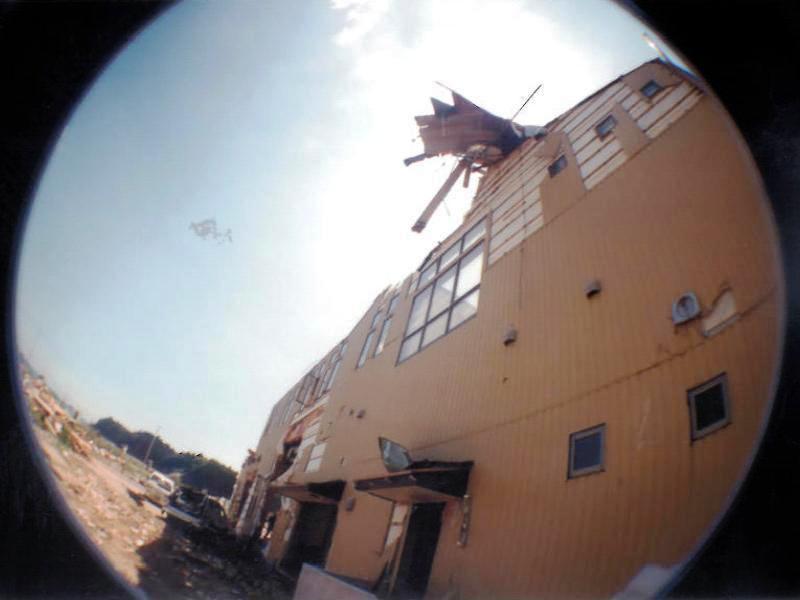
We were doing the usual debris cleanup again and went back to Utatsucho about 5kms North which we’d driven through the night before.  The place was flattened, even my fisheye camera couldn't always get everything in. There was a train line running though the back of town at a height of something like 20 metres up the hillside above sea level. The tracks were bent like they were spaghetti.

There was a bank in town where you could see where the entrance to the lobby was just off the main road becuase of the different exterior floor paving but then there was 10 metres of bare concrete slab before the safe room which was the only thing left standing with a 2 foot (60cm) thick iron girder snapped in two above it.

This cheesy idyllic bathside mural somehow still left intact. 
The main road through Utatsucho was one of the main thoroughfares from North to South and had been cleared by the army some time before. The debris had been dumped on the side of the road and we were separating this and debris that was dragged out of the community centre so it could be diposed properly. Again we were teamed up with a bunch of other teams and there were about 60 of us working on the community centre. Hot as hell so lots of water breaks.

Lots to think about on the way home but looking forward to getting back to Iwaki on July 30.


And for a comparison, here are the two clips. Both taken on the same road heading into Minamisanriku from the NE. 

18 weeks after

7 weeks after

Wednesday, 4 May 2011

Onagawa then and Minamisanriku now

After describing the scene at Onagawa at the start of my last post I managed to find this clip on YouTube which looks like it was taken during one of the times the tsunami was receding. The tsunami came about three or four times that day.

The hospital car park I took the photos from is below and just in front of the person taking this footage. At the start of the clip you can see the damage to the first floor of the hospital on the left, some cars that have been dropped there as the waters rushed out, and . The still-standing white and grey buildings are covered up to about the third floor.

I also uploaded this raw video I took driving back from Minamisanriku last Sunday.

At the end you can see the red skeleton of the 3-storey building which was the town's crisis management centre where Miki Endo spent her final moments.

Monday, 2 May 2011

Miyagi

Last Friday I went back up North to Miyagi prefecture with Yoshida-san, the guy from East Wind Ministries that I met at Second Harvest Japan over a month ago. Seven weeks after the tsunami and some supply lines are starting to get re-established but there's still a long way to go. Small businesses, supermarkets, corner-shops and home centres are opening up around Ishinomaki, which is one of the main towns on the coast not far from the capital Sendai.

The main goal was to deliver food and supplies to home refugees in Onagawa and Minamisanriku. Others set up soup kitchens in Nobiru which is on the other side of Ishinomaki and others were cleaning up houses and clearing out the sewers and drains in Ishinomaki itself.

It's been seven years since I first came through this area. Living in Sydney at the time, a surf-trip through Tohoku (NE Japan) helped me decide to move to Tokyo in 2005. I took the coast-road wherever I could and ended up passing through what seemed like every small Pacific-facing coastal town in Tohoku. The beaches and ocean reminded me of Australia, the hills and forests reminded me of Wales. 

It was one thing to watch the endlessly repeating tsunami scenes on TV; what one reporter called 'earthquake porn', but to be back in Onagawa, in the carpark of the Hospital and look down over what was left was a humbling experience.
The telegraph pole in the foreground is 10 metres tall. The height of the tsunami is usually given at around 16-18 metres but the Japan Times reported in this article that in Iwate prefecture just to the North of here, it may have even reached 38 metres. That telegraph pole is 10 metres tall.

Click on the pano below for a closer look.
The guy who took us here said that when the tsunami hit, the water completely covered the grey five-storey building in the middle of the photo above. A few people had escaped to the roof-top but then had to climb to the very top of the water tank. They managed to hold on and survived.

I took all these photos above from the hospital car-park which is up on a hill. If you look out to sea in the photo above, you'd think this carpark would be a safe evacuation zone but even this wasn't high enough. The tsunami overflowed the whole car park by a couple of metres and went on to fill the whole first floor of the hospital behind. Every car in the car park and most of the people trying to shelter here were washed away.

This is the other side of the hill from the hospital and just beyond this picture there are people living in houses which are pretty much OK. Water-damaged but structurally sound. These were the home refugees who we'd brought the food and supplies for. The evacuation shelters now have their established lines of supply from the government and other agencies but these people can't register as their homes are still standing.

Those who can leave have left, but those who are still here can't sell their house and move (would you want to buy?) they can't sell their car as it's gone, they have no other family plus they've lost their jobs. Eventually the shelters may find room for them as others move out into temporary housing, or they may find a way to move out for good but in the meantime they just need help while things get figured out.


We hadn't arranged a specific time to drop the stuff off, but when we pulled up in the truck, people just appeared. Some of them came with wheelbarrows, some just carried stuff home in their arms but they all just took what they needed. No hoarding, no rushing for the best stuff, just very practical and deeply grateful.

Before I left I'd heard that nearby Ishinomaki didn't need additional food supplies any more but the tears of appreciation from one of these old ladies in Onagawa showed it's different around here. 

It's great that In Ishinomaki the focus seems to be shifting to cleaning-up and rebuilding, but when you're talking about the whole situation in Japan, there just isn't one answer to the question, "what do they need now?" It changes every day and varies hugely place to place.

Back in Ishinomaki there were still long lines at the supply points in town. The team I was with have been here since the day after the tsunami and came in from Yamagata. They know the people running the evacuation centre in town well and are organizing a kids concert on Thursday so we stopped off for a bit.

 I didn't feel comfortable taking photos inside, and anyone who knows me knows me knows I'm not really an "aren't they cute" kind of kids person, but you'd have to be nearly dead yourself not to be struck by the the optimism in these kids' paintings stuck up on the walls of the evacuation centre.

 Crossing paths with the Second Harvest Japan guys in Ishinomaki. They've been doing these runs non-stop.

Overnight lodging was free in a log-house at a campground with a volunteer-friendly owner. Before kipping down for the night, I checked facebook on my mobile and realised it was the day of the royal wedding. 

 Welsh landscape in Miyagi Prefecture, Japan

My ten-foot-tall, six-speed, five-litre, six-wheel, two-ton truck. What would Isuzu call such a beast? The Isuzu ELF. This is Yoshida-san getting ready to help load up. We travelled up together from Tokyo on Friday morning and I dropped him off when I left on Sunday so I was pretty much with him the whole time. His English is better than he thinks so we spoke some English but mostly Japanese.

He was a good guy and as I could tell from his East Wind Ministries business card, a devout Christian. I hardly knew him before we left and had been a bit worried he was going to bang on about faith the whole way. Just what you need on an 11-hour drive. All Friday and Saturday he was fine but then on Sunday morning I was sure the moment had arrived. He asked me in tentative English, "So, Phil-san, do you.... do you... do you pray...?" Ah, here it is I thought. Then he said, "...sports?", "Do you pray sports?"

After 6 years here I'd been caught out by the old "r" and "l" mix-up again, and should have known better anyway!

We stopped off to buy some veggies at one of the local businesses that are back up and running for today's run to Shizugawa which is bascially the old name of Minamisanriku. The owner of the veggie shop was a good bloke who when he realised I was from Wales, supportively said he loved Old Parr Scotch. Good on him though, he gave us a couple of extra trays of bananas and kiwifruit to take with us.


About 32 trashed cars.  

Putting the poles back up.

 Driving into Minamisanriku the Japanese Self-Defence Force (JSDF) tents and trucks were everywhere. These are the guys doing the real heavy lifting. They were the guys who cleared the main roads for traffic in the first few weeks and there is still no end in sight.

Coming over the hill into Rikuzentogura, the main bridge in town had been washed away so the JSDF had built this temporary replacement. This one small bridge cuts 15 kms off the journey from Ishinomaki and opens up a much wider area South of here for the recovery workers.

Minamisanriku; what's left of the town where Miki Endo saved thousands.
 We were heading about a kilometre further round to deliver food and goods to more home refugees whose houses were on higher ground. There are about 100 homes in the area without power or water but in good shape and providing shelter for about 400 people.

We'd called the town's officer-in-charge, the chief, on his mobile phone beforehand and arranged to meet him at a specific meeting point at 11am. We had a good run and got there early at about 10:15 but there were already about 30 smiling faces there waiting for us. Most were over 60s with a few youngsters. A lot of working-age families in rural Japan move to the big cities for work then only move back to retire.

The chief was full of energy and doing a great job in keeping everyone's morale up. When they'd received some food parcels the week before he had them all playing rock-scissors-paper to decide who got the tastiest goodies.

Everyone helped to unload the truck. I was in the back pasing down boxes and was trying to keep the lighter ones for the older women. It was nearly impossible though and as I slowly passed down this box of food weighing about 10 kgs to one frail looking old lady, I warned her it would be heavy. With a big grandmother's smile she said, "the heavier the better!"

While we were in the area, the chief recommended we carry on further round to towns along the coast to see what their needs were. We found an old people's home being used as an evacuation centre who said they were basically OK for food but needed a generator, and work. No-one has jobs any more but there is a ready and willing workforce of small industry workers and fisherman who are out of work and willing to do anything. We couldn't help with the work, yet, but Yoshida-san has already sourced a generator for them in Sendai and will be taking it back on Wednesday.


On the way back we found a restaurant overlooking the ocean which was open for business, no meals, but selling fresh-roasted coffee and ice-cream. The owner had always had his own generator for backup purposes so was one of the first to re-open a week or two ago. This spot would have been idyllic under normal circumstances but we spent a pleasant half-hour with the owner and three others. Two of them were old regulars from Sendai who had come down to help with the clean up and another guy had driven all the way from Fukuoka on the Western-most island of Kyushu.

From the deck there was a sweeping view of the coast. The owner was there when the tsunami came and showed us pictures from that day where you could see the water reaching about halfway up to the first window of the building on the left. You could also see islands of debris, what was once Minamisanriku, being swept out to sea.
As we were paying to leave I noticed a home-made mix CD by the till with tracks like Back in Black by AC/DC and Rock'n'Roll by Led Zeppelin. The music he was playing though was very different, very Norah Jones, laid-back, smooth jazz type of stuff so I asked him if he was into a bit of heavy rock. He told me it was a CD his son had put together of his favourite tracks which he liked to play when he was in.

One of the old locals asked how his son was, and where he was... the owner just shook his head. His son was in Ishinomaki when the earthquake struck and had been killed by a head injury when the house he was in collapsed. He took some solace from the fact that his son had not known anything of the tsunami that he'd seen so clearly and had just been showing us pictures of, and the fact that his son was not one of the more than ten thousand still missing.

Sunday, 27 March 2011

Tohoku: More Before


 I've been watching this home video quite a lot lately. I put it together after a surf-trip from Tokyo to Tohoku, Northern Japan in September 2004, four months before I moved up here. In fact, this trip played a big part in me making the move up here from Sydney.

Looking back, the choice of the first track, the cheery tone, the opening shot, all seem very inappropriate now, but it is what it is. After all, this was over 6 years ago when no-one had any idea what was coming. 

A lot of memories. Every surfer I met whether it was in Ibaraki, Fukushima, Iwate, Miyagi or Aomori was pleased to see me, there was no locals-only attitude, everyone was really mellow and just stoked. The waves weren't perfect, but man they were fun. It reminded me of why I got into surfing in the first place. Some more stills to follow at some point.